

 DE
DE


LCD, OLED und AMOLED: die Unterschiede für Reparaturtechniker erklärt
30-04-2026 • Lesezeit: 4 min

Als Reparaturtechniker arbeitest du täglich mit verschiedenen Arten von Displays, die Technologien wie LCD, OLED und AMOLED nutzen. Das Verständnis dieser Displaytechnologien hilft dir, schneller die richtige Diagnose zu stellen und die richtigen Entscheidungen während einer Reparatur zu treffen.
In diesem Blog erklären wir klar die Unterschiede und wie du dieses Wissen in der Praxis anwenden kannst.
Was ist der Unterschied zwischen LCD, OLED und AMOLED?
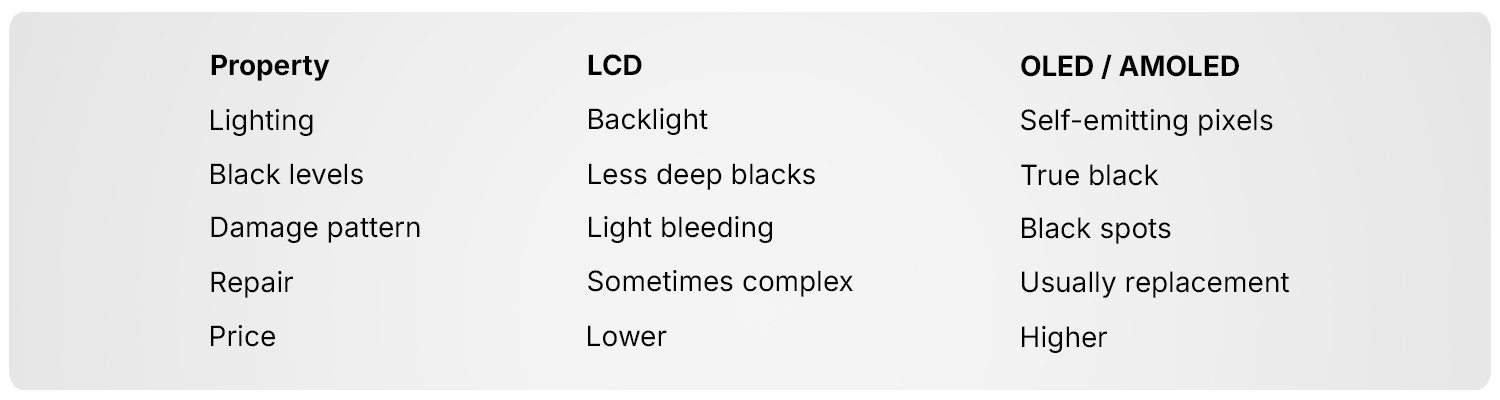
LCD-Displays verwenden eine Hintergrundbeleuchtung (Backlight), während OLED- und AMOLED-Displays pro Pixel selbst Licht erzeugen. Dadurch bieten OLED- und AMOLED-Displays tiefere Schwarzwerte und einen besseren Kontrast, sind jedoch oft teurer und empfindlicher bei Beschädigungen.
Warum ist Displaytechnologie bei Telefonreparaturen wichtig?
Der Displaytyp bestimmt:
- Wie du eine Diagnose stellst
- Welche Teile du bestellst
- Wie du die Reparatur durchführst
- Was du dem Kunden in Bezug auf Preis und Qualität kommunizierst
LCD-Display: der Klassiker mit Hintergrundbeleuchtung
LCD (Liquid Crystal Display) ist eine Technologie, die seit Jahren verwendet wird, insbesondere in älteren Modellen wie dem iPhone 8, iPhone SE (2020 / 2022) und iPhone XR.
Merkmale:
- Funktioniert mit einer Hintergrundbeleuchtung (Backlight)
- Bestaat uit meerdere lagen
- Over het algemeen goedkoper
Was sieht man bei Schäden?
- Weiße Flecken
- Kein Bild, aber Beleuchtung vorhanden
- Streifen oder Verfärbungen
Reparaturhinweis:
Bei LCD kann das Problem manchmal an der Hintergrundbeleuchtung liegen und nicht am Panel selbst. Das macht die Diagnose anders als bei OLED-Displays.
OLED-Display: Pixel, die selbst Licht erzeugen
OLED (Organic Light Emitting Diode) ist ein Fortschritt in der Displaytechnologie und wird in Smartphones wie dem iPhone 14, iPhone 15, iPhone 16 und iPhone 17 verwendet.
Merkmale:
- Keine Hintergrundbeleuchtung erforderlich
- Jeder Pixel erzeugt selbst Licht
- Tiefere Schwarzwerte und besserer Kontrast
Was sieht man bei Schäden?
- Schwarze Flecken (kein Licht = tote Pixel)
- „Ink-Bleeding“-Effekt
- Teilweise ausfallendes Display
Reparaturhinweis:
Wenn ein Teil des Displays schwarz bleibt, ist fast immer das Display selbst defekt. Die Reparatur bedeutet daher meist: Austausch des kompletten Displays.
AMOLED-Display: die fortschrittliche Variante
AMOLED (Active Matrix OLED) ist eine Weiterentwicklung von OLED und wird häufig in High-End-Smartphones eingesetzt, wie der Samsung Galaxy S- und Note-Serie, der Samsung Galaxy A-Serie sowie OnePlus-Geräten.
Merkmale:
- Schnellere Reaktionszeit und bessere Effizienz
- Dünner und flexibler
- Oft höhere Qualität und teurer
Reparaturhinweis:
In der Praxis arbeitest du bei OLED und AMOLED nahezu gleich. Die größten Unterschiede liegen in:
- Qualität
- Preis
- Anwendung (meist Premium-Geräte)
 Banner 1.png 527.17 KB
Wichtigste Unterschiede zwischen LCD- und OLED-Displays
 Banner 4.png 54.36 KB
Was bedeutet das konkret für deine Reparaturen?
1. Schnellere Diagnose
Du erkennst sofort, ob das Display selbst defekt ist oder ob ein anderes Problem vorliegt.
2. Bessere Preis-Kommunikation
Du kannst Kunden erklären, warum ein OLED-Display teurer ist als ein LCD.
3. Geringeres Risiko bei Reparaturen
Du weißt, welcher Displaytyp empfindlicher ist und worauf du achten musst.
4. Die richtigen Teile bestellen
Keine Verwechslung mehr zwischen LCD- und OLED-Varianten desselben Geräts.
Foneday-Tipp 💡
Arbeitest du mit verschiedenen Qualitätsstufen wie Original, kompatibel oder refurbished? Dann ist es besonders wichtig, den richtigen Displaytyp (LCD oder OLED/AMOLED) zu wählen. So kannst du Preis und Qualität besser auf die Erwartungen deiner Kunden abstimmen.
 Banner 2.png 561.14 KB
Fazit
Du musst kein Spezialist für Displaytechnologie sein, aber ein gutes Verständnis von LCD, OLED und AMOLED macht deine Arbeit als Reparaturtechniker:
- Effizienter
- Präziser
- Professioneller
Bei Foneday findest du für jeden Displaytyp die passende Lösung, vom günstigen LCD bis zum High-End-OLED. So kannst du jede Reparatur effizient durchführen.
Bleiben Sie über die neuesten Entwicklungen und Updates auf dem Laufenden, indem Sie unsere Blogs lesen und uns auf LinkedIn folgen.


