

 SV
SV


LCD, OLED and AMOLED: the differences explained for repair technicians
30-04-2026 • Lästid: 3 min

As a repair technician, you work daily with different types of screens that use technologies such as LCD, OLED, and AMOLED. Understanding these display technologies helps you diagnose issues more quickly and make the right decisions during a repair.
In this blog, we clearly explain the differences and how you can apply this knowledge in practice.
What is the difference between LCD, OLED, and AMOLED?
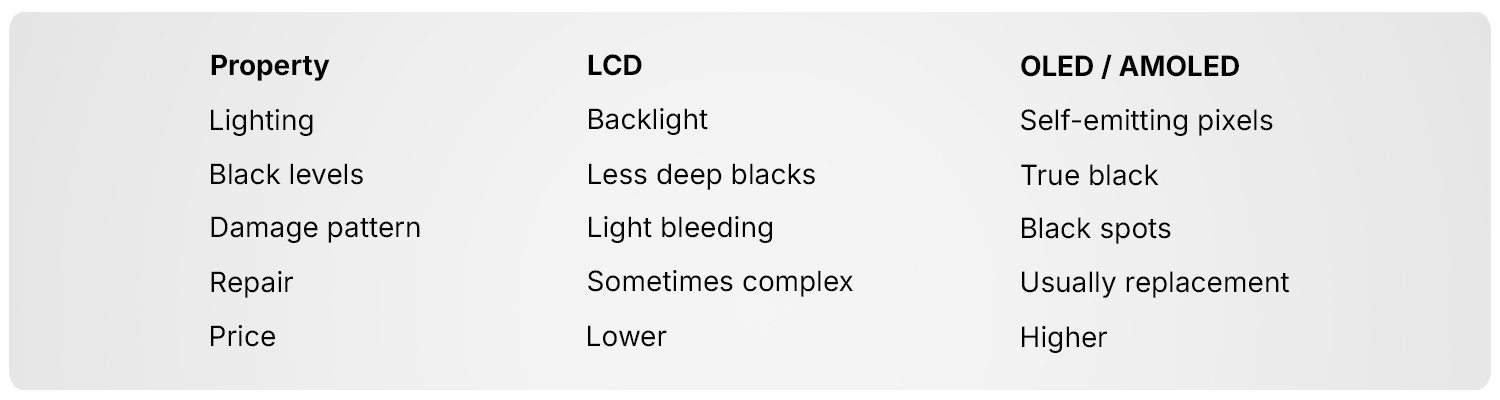
LCD screens use a backlight, while OLED and AMOLED displays emit light per individual pixel. As a result, OLED and AMOLED screens offer deeper blacks and better contrast, but they are often more expensive and more sensitive to damage.
Why is screen technology important in phone repairs?
The type of screen determines:
- How you perform a diagnosis
- Which parts you order
- How you carry out the repair
- What you communicate to the customer in terms of price and quality
LCD screen: the classic with a backlight
LCD (Liquid Crystal Display) is a technology that has been used for years, especially in older models such as the iPhone 8, iPhone SE (2020 / 2022), and iPhone XR.
Characteristics:
- Uses a backlight (background lighting)
- Consists of multiple layers
- Generally more affordable
What do you see when damaged?
- White spots
- No image, but the backlight is still on
- Lines or discoloration
Repair insight:
With LCD, the issue can sometimes be in the backlight rather than the panel itself. This makes your diagnosis different compared to OLED screens.
OLED Display: pixels that emit their own light
OLED (Organic Light Emitting Diode) is a step forward in display technology and is used in smartphones such as the iPhone 14, iPhone 15, iPhone 16, and iPhone 17.
Characteristics:
- No backlight required
- Each pixel emits its own light
- Deeper blacks and better contrast
What do you see when damaged?
- Black spots (no light = dead pixels)
- “Ink bleeding” effect
- Partially failing display
Repair insight:
If part of the screen stays black, it is almost always the display itself that is defective. In most cases, repair means replacing the entire display.
AMOLED Display: the advanced variant
AMOLED (Active Matrix OLED) is a further development of OLED and is widely used in high-end smartphones, such as the Samsung Galaxy S and Note series, Samsung Galaxy A series, and OnePlus devices.
Characteristics:
- Faster response time and better efficiency
- Thinner and more flexible
- Often higher quality and more expensive
Repair insight:
In practice, working with OLED and AMOLED is very similar. The main differences are in:
- Quality
- Price
- Application (typically premium devices)
 Banner 1.png 527.17 KB
Key differences between LCD and OLED displays
 Banner 4.png 54.36 KB
What does this mean in practice for your repairs?
1. Faster diagnosis
You can immediately recognize whether the screen itself is defective or if something else is causing the issue.
2. Better price communication
You can explain to customers why an OLED screen is more expensive than an LCD.
3. Less risk during repairs
You know which type of screen is more fragile and what to watch out for.
4. Ordering the right parts
No more confusion between LCD and OLED variants of the same device.
Foneday tip 💡
Do you work with different quality grades such as original, compatible, or refurbished? Then it’s even more important to choose the right screen type (LCD or OLED/AMOLED). This way, you can better match price and quality to your customer’s expectations.
 Banner 2.png 561.14 KB
Conclusion
You don’t need to be a specialist in display technology, but a solid understanding of LCD, OLED, and AMOLED makes your work as a repair technician:
- More efficient
- More accurate
- More professional
At Foneday, you’ll find a suitable solution for every type of display, from budget LCD to high-end OLED. This allows you to carry out every repair efficiently.
Stay up to date with the latest developments and updates by reading our blogs and following us on LinkedIn.


